Patient Guide
UnderstandingChoroidal Melanoma
A simple guide for patients and families to understand choroidal melanoma, including its symptoms, diagnosis, treatment options, and what to expect.
Updated August 2026
A message from Dr. Martin
Hearing the words "eye cancer" can feel overwhelming. It's completely natural to have questions and concerns.
This guide was written to explain choroidal melanoma in clear, everyday language. My goal is to help you better understand the condition, the tests you may need, and the treatments available so you can feel more informed and prepared for the next steps.
About this guide
This guide was written by Dr. Andrei Martin, an internationally trained ocular oncologist, to help patients and their families better understand choroidal melanoma.
The information is intended to explain the condition in clear, everyday language. It should not replace a consultation with your eye doctor, who can provide recommendations based on your individual situation.
Before You Continue
The most importantthings to know
Choroidal melanoma is a rare type of eye cancer.
Many people have no symptoms when it is first discovered.
Modern treatments can often control the cancer while preserving the eye.
Regular follow-up is important even after successful treatment.
What is choroidal melanoma?
Understanding the condition
Choroidal melanoma is a type of eye cancer that develops inside the eye. It begins in the choroid, a layer beneath the retina that supplies oxygen and nutrients to the back of the eye.
Although uncommon, it is the most common eye cancer that begins inside the eye in adults. Many people have no symptoms when it is first discovered, which is why it is often detected during a routine dilated eye examination.
At a glance
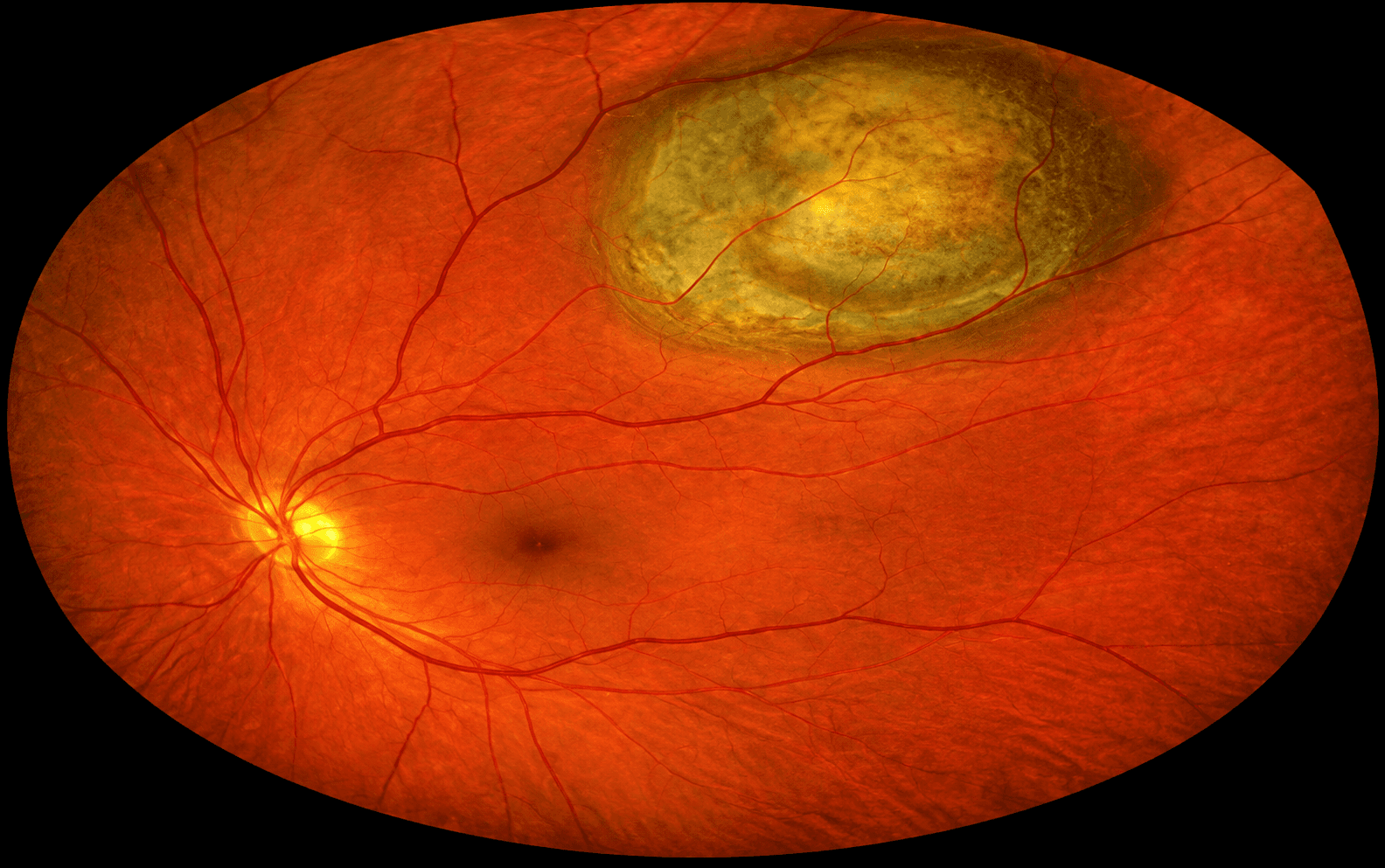
Figure 1. Wide-field retinal photograph showing a choroidal melanoma. The appearance of a choroidal melanoma can vary depending on its size, color, and location within the eye.
Looking Ahead
There is reason to be hopeful.
Hearing the words "eye cancer" can be overwhelming. Fortunately, treatment has advanced tremendously over the past few decades. Today, many patients can be treated while preserving the eye, and in many cases, useful vision.
Every person's situation is different. Your ocular oncologist will recommend the treatment that offers the best balance between controlling the tumor, preserving vision whenever possible, and protecting your long-term health.
What symptoms can it cause?
Many people with choroidal melanoma have no symptoms, especially when the tumor is small. In many cases, it is discovered during a routine eye examination before it affects vision.
Blurred Vision
The tumor may affect the retina, causing blurred or distorted vision.
Flashes of Light
Some patients notice brief flashes of light, especially if the retina becomes irritated.
New Floaters
New spots, specks, or cobweb-like shapes may appear in your field of vision.
Shadow in Vision
A larger tumor can create a shadow or missing area in your side vision.
No Symptoms
Many choroidal melanomas are found during a routine eye examination before any symptoms develop.
When should I see an eye doctor?
These symptoms do not always mean you have choroidal melanoma. Many common eye conditions can cause similar symptoms. However, if you notice new flashes, floaters, blurred vision, or a shadow in your vision, you should arrange a prompt eye examination.
How is it diagnosed?
If your eye doctor suspects a choroidal melanoma, several painless tests can help confirm the diagnosis. Each test provides different information about the tumor and helps determine the most appropriate treatment.
👁️ Dilated Eye Examination
Eye drops are used to enlarge the pupils so your doctor can examine the retina and choroid. This is often the first step in detecting a choroidal melanoma.
📷 Retinal Photography
High-resolution photographs document the size, shape, and location of the tumor. They also allow your doctor to compare future images and monitor for changes over time.
📡 Ocular Ultrasound
Ultrasound uses sound waves to measure the thickness and internal characteristics of the tumor. This is one of the most important tests used to confirm the diagnosis.
🔬 OCT Scan
Optical Coherence Tomography (OCT) creates detailed cross-sectional images of the retina and can detect fluid or swelling caused by the tumor.
Good to know
Most of these tests are painless and can be completed during a single clinic visit. Together, they help your ocular oncologist confirm the diagnosis, measure the tumor accurately, and recommend the treatment that is best suited to your condition.
When should I seek medical attention?
Contact your eye doctor promptly if you notice:
- • Sudden worsening of vision
- • New flashes of light or floaters
- • Increasing eye pain
- • A curtain or shadow in your vision
How is it treated?
The best treatment depends on the size of the tumor, its location inside the eye, your vision, and your overall health. Your ocular oncologist will recommend the option that offers the best chance of controlling the tumor while preserving the eye whenever possible.
☢️ Radiation Therapy
Radiation is the most common treatment for choroidal melanomas in first world countries. The goal is to destroy the tumor while preserving the eye and, when possible, useful vision.
👁️ Eye Removal (Enucleation)
If the tumor is very large or the eye has already lost useful vision, removing the eye may provide the safest treatment. This is the most common treatment in the Pilippines. A natural-looking artificial eye can usually be fitted after surgery.
📅 Regular Monitoring
Some very small tumors may not require immediate treatment. Instead, your doctor may recommend careful monitoring with photographs and ultrasound scans to watch for growth.
🩺 Personalized Care
Every patient is different. Your treatment plan will be tailored to your individual situation after discussing the benefits and potential risks of each option.
A note from Dr. Andrei Martin
Hearing that you have an eye tumor can be overwhelming. The good news is that treatment has advanced significantly over the years, and many patients can be successfully treated while preserving the eye. Together, we will discuss your diagnosis, answer your questions, and choose the treatment that is most appropriate for you.
Common Questions
Questions patientsoften ask
No. Although both begin in pigment-producing cells called melanocytes, choroidal melanoma develops inside the eye and behaves differently from melanoma of the skin.
Not always. Many patients can now be treated with radiation while keeping the eye. The best treatment depends on the size and location of the tumor, as well as the vision in the affected eye.
Yes. Choroidal melanoma can spread, most commonly to the liver. This does not happen in every patient, but regular follow-up and systemic monitoring are an important part of long-term care.
It can. The effect on vision depends on the size and location of the tumor and the type of treatment. Your doctor will discuss the expected visual outcome based on your individual situation.
Continue Learning
You may also findthese guides helpful
Understanding Choroidal Nevus
Learn how a choroidal nevus differs from choroidal melanoma and why regular monitoring is important.
Coming Soon
Understanding Retinoblastoma
A patient-friendly guide to the most common eye cancer in children.
Coming Soon
Eye Tumors: An Overview
An introduction to the different types of tumors that can affect the eye and surrounding tissues.
Coming Soon
Need a Second Opinion?
We're here to help.
If you or a loved one has been diagnosed with choroidal melanoma, we're here to answer your questions and discuss the treatment options that are right for you.